HRCSA is Chemically Active

Posted on

When the word “Coating” is used, most people think of a paint that forms into a solid barrier film.

The HRCSA Self-Priming Topcoat is an unconventional coating system which is both chemically active and elastomeric.

Traditional barrier or sacrificial barriers cure across the steel micro voids leaving areas of exposed steel between the coating and the substrate – these micro void areas are vulnerable to rapid undercutting once the barrier is breached.

Typical causes of newly applied coating breaches: Workers walking on fresh coating during construction and take-down. Mechanical damage (tools being dropped), stone chips, debris, etc.

HRCSA is a reacted calcium sulfonate, calcium carbonate based complex that fully wets the surface as it neutralizes acids, displaces moisture and scavenges oxygen leaving no micro voids unfilled.

The high ratio of active calcium sulfonate thoroughly wets the micro voids creating a mono-molecular layer of cations which ensure chemical neutrality and no undercutting if the coating is breached. ( The HRCSA reacted formulation’s uniqueness is what gives it this performance advantage.) <Link to Specifications>

The role and function of HRCSA calcite platelets.

Once applied, the formulation’s artificially grown calcite crystals line up like fish scales to form a strengthened film with extended pathways for moisture and oxygen.

When acidic moisture (acid rain) passes through these crystals, a minute amount of the calcite dissolves to create a neutral base liquid void of acidity at the steel substrate.

Summarily, it neutralizes acids, displaces moisture, and scavenges oxygen.

HRCSA Penetrant/Sealer + HRCSA Self Priming Topcoat = Meld

When the word “Penetrant” is used, most people think of a low molecular weight epoxy or moisture cured urethane penetrants which were primarily designed to bind up existing rust on steel surfaces and a tiecoat.

Low molecular weight penetrants applied into active corroded connections do not chemically neutralize the active corrosion. Because they are epoxies or MCUs, they harden and then crack whenever movement occurs.
This explains why rust bleeding from connections can usually be seen < 2 years after application – the corrosion was never stopped.

HRCSA meld coat is both chemically active AND flexible.

Crevice corroded and pack-rusted joints and connections that are properly prepared (flushed, salt mitigated and dried) then pressure filled to refusal with HRCSA Penetrant-Sealer, Meld-coated with HRCSA self-priming topcoat and overcoated with same (wet on wet), creates a chemically active, flexible seal that actively stops corrosion inside the connection for years (even decades) to come.

Because the chemistry stays active in the connection allowing the structure to move without damaging the film.

HRCSA can applied by spray, brush or roller to anything Fe – including: steel of any type, as well as overcoating tightly adhered, contaminant-free existing coatings.

Pressure-Applying HRCSA Penetrant into flushed out, blown dried, cleaned corroded crevices before application of the HRCSA meld-coat.

Pack-rusted connections saturated with HRCSA Penetrant.

Application of HRCSA meld coat (thick layer of HRCSA self-priming topcoat overtop HRCSA Penetrant).

Same pack-rusted connection filled with HRCSA self-priming topcoat over top of HRCSA Penetrant filled connection.

HRCSA Penetrant inside tubes or enclosed areas.

HRCSA Penetrant can be fogged, or mist applied inside tubes.

Visualization of how the HRCSA Penetrant/Sealer fills the inside of steel tubes when applied with a sprayer fitted with a flexible rust proofing wand with a star tip.

Bearings, Pin Connectors, Interfaced steel

Once all connections are treated properly, the entire steel structure is overcoated with HRCSA self-priming topcoat. Single component, single coat application makes for shortest coating application times in the industry.

HRCSA applied between the bolted in reinforcement plates keep corrosion activity from taking place between the two.

Weathering (A588, COR-TEN) steel

Posted on

HRCSA: Solving steel corrosion problems others choose to ignore.

Hydro towers are surface prepared by power tool cleaning using angle grinders to remove scale, solvent wipe followed by pressure applied HRCSA Penetrant/Sealer inside the connections (as seen in the photo on left) and HRCSA Self Priming Topcoat by paint brush applied to stripe coat bolts, hard edges and final overcoating the entire zone.

Where A588, COR-TEN steels produce corrosion concerns, Chemically Active HRCSA is becoming the “go to” coating system because of it’s a) minimalistic surface preparation requirements, b) ability to chemically stop crevice corrosion, ability to fully wet weathering steel substrate, d) durability and e) HRCSA IS NON-CONDUCTIVE UP 100KVA – AN IMPORTANT FEATURE FOR COR-TEN TOWERS BECAUSE CORROSION PRODUCTS CAUSE ARCHING ON COR-TEN STEEL TOWERS.

COR-TEN steel performs impressively on flat surfaces, but, like all systems, has limitations – particularly where there are connecting plates and other regions noted below.

Performance & ConditionWeathering Steel  Performance & Condition  Weathering Steel  
Fatigue Life  Reduced by weathering  Road Salt EffectAccelerated corrosion and loss of section and mass
Constant WettingCorrodes the same as unprotected carbon steelAppearance ProblemsStains concrete
Faying SurfacesCorrodes the same as unprotected carbon steelSea Coast EnvironmentPoor corrosion protection, chlorides cause pitting and rapid section loss
PaintingExpensive preparation and excessive paint absorptionChemical (Airborne) ContaminationPoor corrosion protection, accelerated patina consumption
Tubular ShapesTraps moisture inside, resulting in increased corrosion rateVegetationMoisture may accelerate corrosion, especially on faying surfaces, enough to exert excessive force on bolted connections
InspectionCan’t distinguish patina rust from loose corrosion products of accelerated corrosionElectrical IndustryCorrosion products cause arcing
Corrosion RateUnknownHigh humidity/FogPoor corrosion protection

More complex joints and connections (such as the above) are surface prepared using power tool cleaning to remove scale then high pressure water cleaned to remove salts, oil, dirt, etc.

Photo above: High pressure water cleaned COR-TEN steel (with salt remover) is ready for HRCSA coating application where HRCSA Penetrant/Sealer is pressure-applied inside the bearing joint and the HRCSA Self-Priming Topcoat is applied (wet-on-wet) to the entire zone to be painted.

Inside Box Beams and other Tubular shapes.

Using a Star tip for fogging and misting HRCSA Penetrant/Sealer is fogged and applied inside Box Beams and other Tubular shapes to create a polar bonded anti-corrosive coating on the inside where humidity can otherwise cause serious corrosion damage.

HRCSA Coating Life Expectancy

Posted on

Coating life expectancy.

Japanese and American lab tests predict that the HRCSA coating system (250 microns recoat) will last 40+ years in the field.

Field erosion tests measured losses at a rate of 25 microns every 5,6 years.

Unfortunately, none of these performance predictions mean anything if the structure they are being applied to is being torn apart by structure critical corrosion.

Primary Reasons For Collapses.

Bent plates, loss of fasteners, loss of section, weakened girders, Ongoing section loss due to corrosion can negatively impact load ratings over time.

Corrosion frozen moving parts induce great stress to the superstructure and may induce microcracking, bending and misalignment of critical components.

Corrosion within the strands can affect structural integrity and load carrying capabilities. [PS: HRCSA offers OUTSTANDING wire rope coating solutions! Enquire below.]

Leaking expansion joints affect piers, bearings, bends, superstructure and substructure elements.

“Threats to Coating Service life.”

Damage / Abrasion / Impact / undercutting

Ph environment, de-icing salts, atmospheric pollution.

Preservation’s primary objective is to extend the service life and utility of existing assets.

  • Cost effective and easily deployed with least amount of delay to the users.
  • HRCSA is 30 year field proven to help solve the specific corrosion issues identified above.

Ask Your Supplier:

  • Does the coating system you propose solve the potential or actual structure critical corrosion problems that are present on my asset?
  • Does the proposed coating system demonstrate the proven ability to chemically stop crevice corrosion, pack rust, free corrosion frozen bearings, on structures with complex geometries and inaccessible areas to stop section loss and compromises to structural integrity?
  • How does your proposed coating systems’ chemistry deal with crevice corrosion, pack rust, corrosion frozen bearings, and complex geometries?
  • What testing, field experience, and case histories can you provide to confirm your system’s demonstrated ability to mitigate the above-mentioned corrosion issues?
  • How is your system cost effective and rapidly deployed to minimize user delays?
  • Do you have peer reviewed publications to back your claims?
  • What type of performance warranty has your solution offering been tied to and can you provide a written example?

Do you have a project in mind? Schedule a meeting.

[contact-field required="1" type="name" label="Name"/] [contact-field required="1" type="email" label="Email"/] [contact-field required="1" type="telephone" label="Phone"/] [contact-field label="Date" required="1" type="date"/] [contact-field label="Time" required="1" options="Morning,Afternoon" type="radio"/] [contact-field label="Notes" type="textarea"/]

Mitigating Crevice Corrosion and Pack Rust

Posted on

There are no words to describe how seeing this a year after abrasive blasting and applying 3 coats makes the owner feel… <disappointed>, <resigned>, <frustrated>, <deceived>

HRCSA: Preserving Steel

When dealing with aged, in-place, corroded structures, traditional film-form coatings do not have the right chemistry needed to stop pack-rust growth.

When bearings freeze due to corrosion, pressure is introduced to the bridge superstructure.

When corrosion build between plates expands and out of plane bending occurs, the integrity of the structure is put at risk, the rating is affected, and fasteners are weakened.

Structure Critical Corrosion Can Shave Years of Service Life off Your Structure.

For years it was believed that “There is nothing you could do about rust bleed leaking from connections.” until as recently as 30 years ago when HRCSA formulations were created specifically to chemically step active corrosion inside connections. Although the HRCSA Self-priming topcoat is applied stand-alone on exposed steel substrate, there is one specific area where it it is provided a boost: inside pack-rusted joints and connections and other steel openings.

Four Simple Steps for Extending the Service Life of Your Steel Assets.

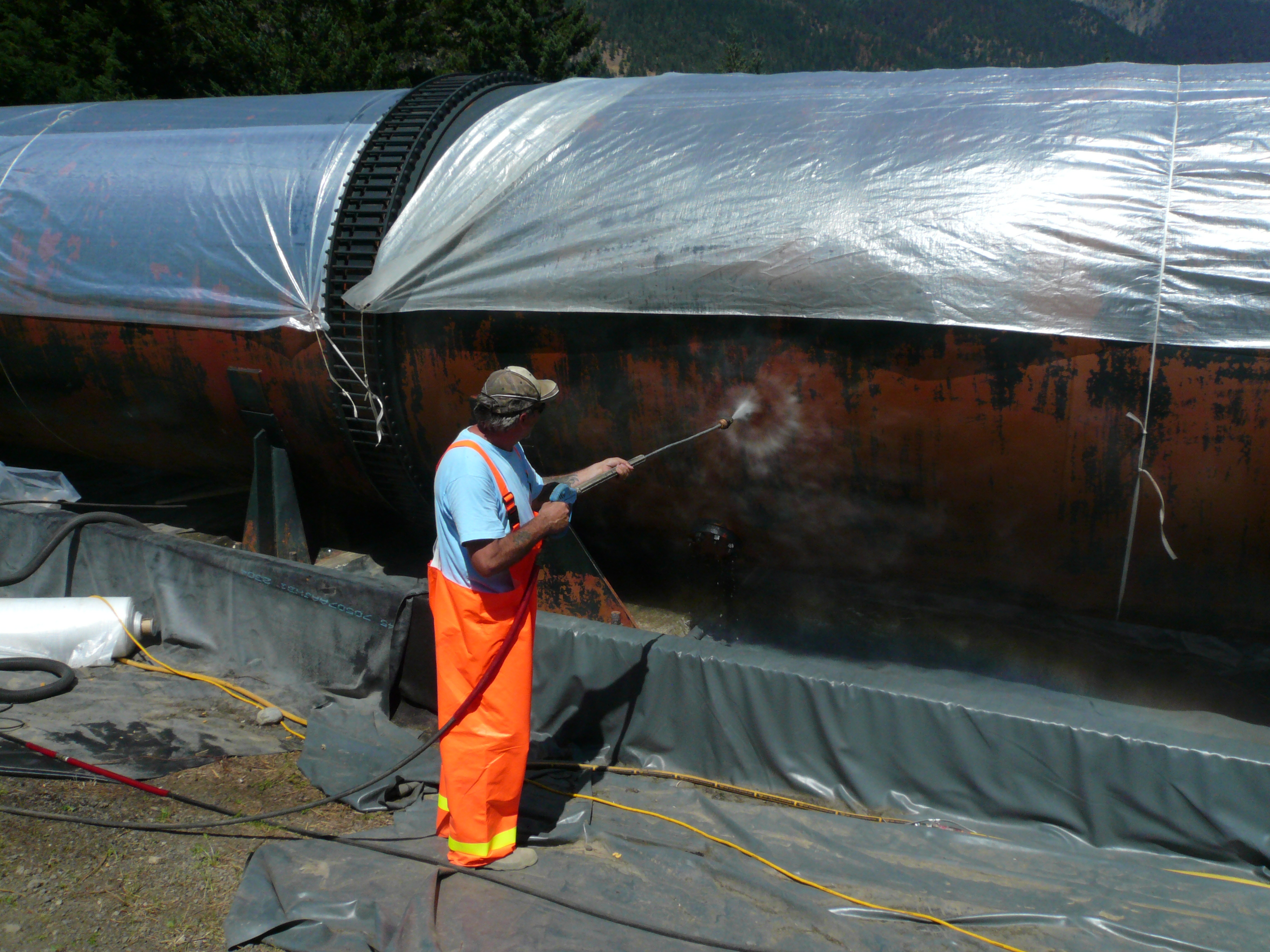
Step 1: High pressure water clean with salt remover to produce a clean, tightly adhered substrate and flushed joints and connections.

Step 2: Apply high pressure air to remove water and humidity from surfaces and inside connections

Step 3: Apply HRCSA Penetrant under pressure to fill capillary channels inside connections.

Step 4: Apply HRCSA Self-Priming Topcoat to Penetrant treated connections, rivet heads and sharp angles using a brush. Overcoat the entire structure.

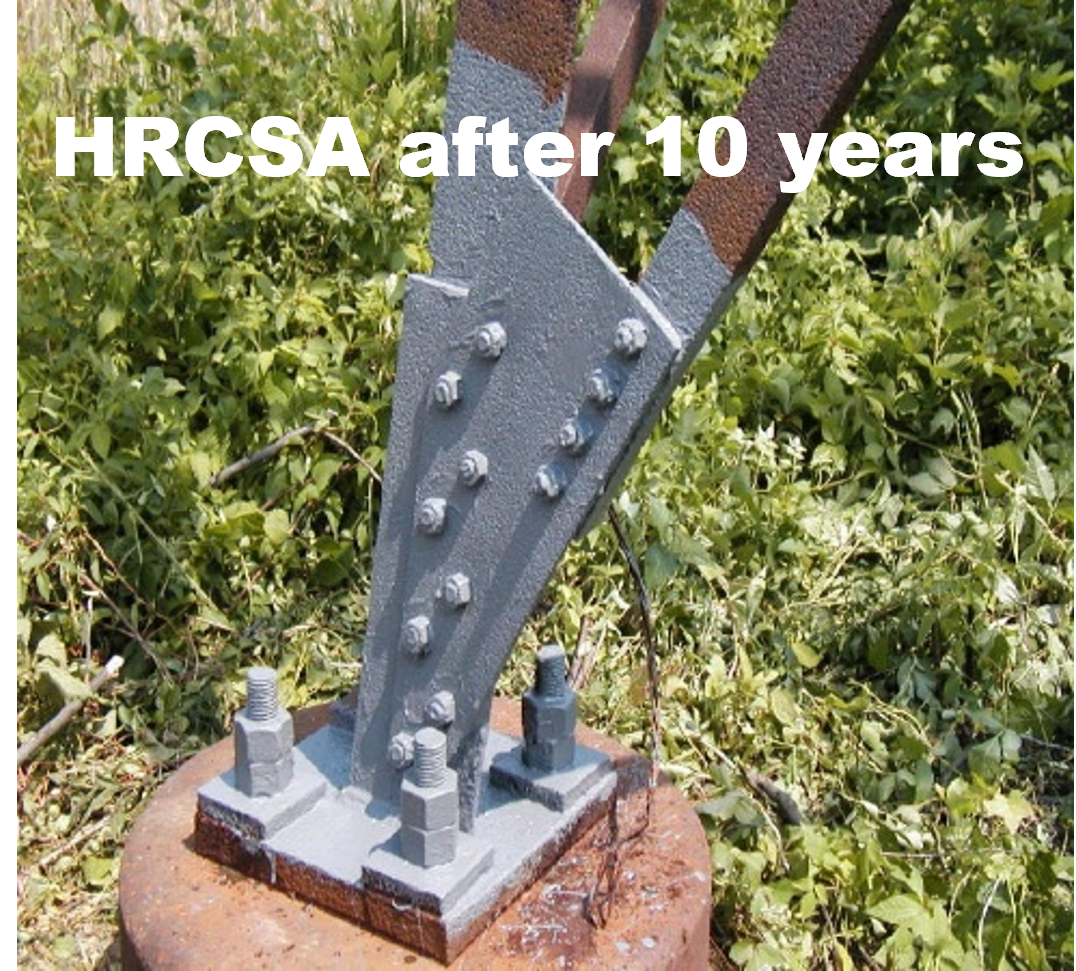
The photo at the bottom is that of an HRCSA treated pack-rusted connection after 17 years in service.

The HRCSA melding process is achieved by first saturating, flushing, and blowing out connections and then flooding the inside of the connections with low viscosity HRCSA Penetrant/Sealer under pressure. This material chemically treats corrosion causing acids inside the crevice corroded or pack rusted joints or connections. Once applied, this material will remain chemically active inside the connection for as long as it is sealed in by the HRCSA Self-Priming Topcoat. Together, they form a mid-layer of chemistry we call the “meld zone”. This meld-zone serves as a chemical reserve that is a continuous source of corrosion-fighting chemistry as HRCSA continually wicks it way deeper and deeper into the crevice during structural movement (expansion and contraction). When this process is applied to bearing plates, the HRCSA chemistry applies lubricity as it frees up corrosion frozen bearings.

Why not stop all corrosion – including crevice corrosion?

[contact-field required="1" type="name" label="Name"/] [contact-field required="1" type="email" label="Email"/] [contact-field required="1" type="telephone" label="Phone"/] [contact-field label="Date" required="1" type="date"/] [contact-field label="Time" required="1" options="Morning,Afternoon" type="radio"/] [contact-field label="Notes" type="textarea"/]

Overcoating Steel Structures

Posted on

Different Technologies, Different Outcomes.

Traditional cross-linking overcoating systems adhere by chemical-mechanical reaction which means that THEY shrink more and more over time stressing the existing overcoated substrate paint systems whereas HRCSA does not shrink meaning that HRCSA overcoated substrate paints will not lift away from the steel as time passes on.

HRCSA overcoat systems adhere through polar bonding and are not reliant on chemical nor mechanical reactions for adhesion producing a low surface energy bond without risk of existing coating delamination.

HRCSA Self-priming topcoat.

Because HRCSA is a chemically active, surface tolerant system, it can be applied to any existing tightly adhered cleaned, salt and black oxide free substrate (avoid applying over rubber or uncured tar). In addition, HRCSA can overcoat tightly adhered, contaminant-free existing coating systems.

Due to HRCSA’s low surface energy, the risk of delamination caused by shrinkage from traditional overcoat systems is very low.

During open forum discussions about structure critical corrosion with chief structural engineers at the Federal Highway and with state bridge authorities, the engineers were disapproving of how ineffective painting structures with traditional barrier coating systems is. Especially with regard to particularly stopping rust bleeding at the crevice corroded connections and corrosion-frozen moving parts and long term reliability.

The low surface energy HRCSA self-priming topcoat does not ‘tug and pull’ (long term) existing substrate coatings – a characteristic that is especially important in cold weather conditions.

The chemically active aspect for the HRCSA self-priming topcoat’s cousin (HRCSA active Penetrant) is field proven to stop structure critical corrosion inside complex joints and connections, moving parts and wire rope.

To discuss a specific project you are considering, please register and the manufacturing licensee in your territory will be notified. Thank you.

[contact-field required="1" type="name" label="Name"/] [contact-field required="1" type="email" label="Email"/] [contact-field required="1" type="telephone" label="Phone"/] [contact-field label="Date" required="1" type="date"/] [contact-field label="Time" required="1" options="Morning,Afternoon" type="radio"/] [contact-field label="Notes" type="textarea"/]