
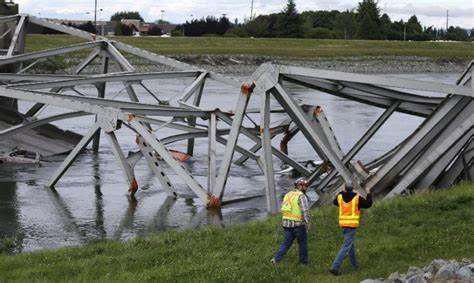
“In 1990, the federal government gave the I-35W bridge a rating of “structurally deficient”, citing significant corrosion in its bearings.“
“The inspection carried out June 15, 2006 found problems of cracking and fatigue.”
I-35W Mississippi River bridge – Wikipedia


It’s Tough Being a Bridge.
Society tends to take it’s infrastructure for granted. We rarely give the structures we depend on for our livelihood little notice (other than perhaps cursing the potholes that mess up our suspensions and alignments).
Nonetheless, those unseen structure critical connections that hold the bridge together are, well, critical. When leaking expansion joints, faulty drainage or nearby pollution emitting plants introduce non-visible contaminants to the steel, insidious damage slowly introduces it’s self in the form of corrosion-frozen moving parts such bearings, pin connectors, wire rope all of which can have a very negative impact on the superstructure’s integrity.
When bearings seize, the superstructure becomes restricted in it’s ability to flex and move with contractions, expansions, traffic load changes and even high winds in some areas.
Additionally, when movements are restricted, imagine the pressures that take place at the connection plates and on the fasteners? In the very least, the coating that’s protecting the connection is sure to crack and let corrosion causing contaminants and water in. Once corrosion sets in inside the connection, the steel at the connection converts into corrosion by-product – which can be 10 times as voluminous as the steel from whence it came – resulting in both thinner steel at the connection AND even more pressure on the fastening plates and fasteners.
Compound this effect with heavy traffic loads, and, well, history has it’s story stories to tell.


Field Proven HRCSA is unique in it’s ability to chemically stop active corrosion INSIDE CORRODING CONNECTIONS (for 15-20 years) and also inside pin connectors, and corrosion frozen bearings.
When it comes to bearings and pin connectors look no further. HRCSA not only stops the corrosion between the plates by displacing moisture, scavenging oxygen and neutralizing acids, but it also causes black oxides to detach from the steel interface (thereby unrestricting it’s movements) while also adding lubricity to the plates and a coating that stretching with microcracking.
How’s that for functional elegance?